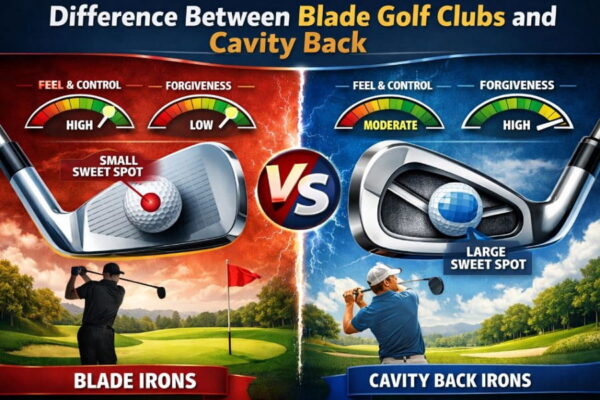
Choosing the right golf irons can feel confusing, especially when deciding between blade golf clubs and cavity back irons. Both look different, feel different, and perform differently on the course. The right choice depends on your skill level, handicap, and what you want from your game.
In this guide, we clearly explain the difference between blade golf clubs and cavity back irons using simple language. Whether you are a beginner, mid-handicap golfer, or an advanced player, this article will help you make the right decision without guesswork.
What Are Blade Golf Clubs?
Blade golf clubs, also known as muscle-back irons, are the traditional style of golf irons. They have a small clubhead, a thin top line, and very little forgiveness.
Key Features of Blade Golf Clubs
Compact clubhead design
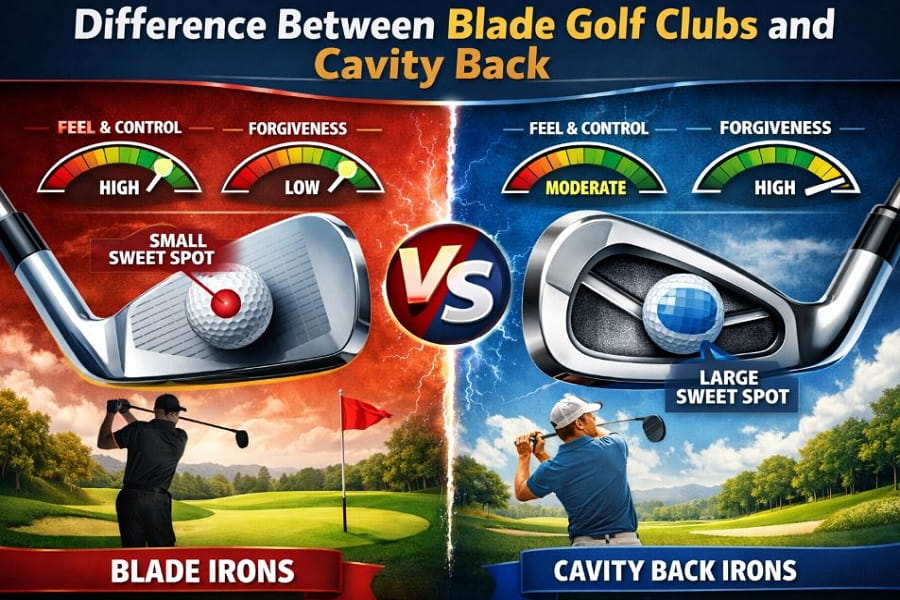
Small, centered sweet spot
Forged metal construction
Minimal offset
Designed for precise shot control
Pros of Blade Golf Clubs
Excellent control over ball flight
Easy to shape shots (fade or draw)
Clear feedback on every strike
Cons of Blade Golf Clubs
Very unforgiving of mishits
Harder to hit consistently
Not ideal for beginners
Blade irons reward clean contact. If you miss the center of the clubface, you will lose distance and accuracy.
Read also more related topics: Difference Between Golf Ball And Baseball
Difference Between Golfers’ Elbow And Tennis Elbow
What Are Cavity Back Golf Clubs?
Cavity back golf clubs are designed to make golf easier. They have a hollowed-out back that redistributes weight around the edges of the clubhead.
Key Features of Cavity Back Golf Clubs
Larger clubhead
Bigger sweet spot
Perimeter weighting
Higher launch angle
More forgiveness
Pros of Cavity Back Golf Clubs
Easier to hit
More consistent distance
Better results on off-center hits
Cons of Cavity Back Golf Clubs
Less shot-shaping ability
Reduced feedback compared to blades
Cavity back irons help golfers hit straighter shots and improve consistency.
Difference Between Blade Golf Clubs And Cavity Back (Side-by-Side Comparison)
Forgiveness
Blade irons: Very low forgiveness
Cavity backs: High forgiveness
Cavity backs protect your score on bad swings, while blades punish mistakes.
Blades vs Cavity Back Distance
Cavity backs maintain distance even on mishits
Blades offer great distance only on perfect strikes
For most golfers, cavity back irons produce more consistent yardages.
Accuracy and Shot Control
Blades: Best for shaping shots
Cavity backs: Designed for straighter shots
Blades suit players who like to control ball movement. Cavity backs suit players who want reliability.
Feel and Feedback
Blades: Sharp and precise feedback
Cavity backs: Softer feel with vibration dampening
Blades let you instantly know where you struck the ball.
Ball Flight and Launch
Cavity backs: Higher launch, easier lift
Blades: Lower, penetrating ball flight
Difference Between Blade Golf Clubs And Cavity Back Handicap
Choosing irons based on handicap is one of the smartest decisions you can make.
Best Irons by Handicap
High handicap (20+) – Cavity back irons
Mid handicap (10–20) – Cavity backs or combo sets
Low handicap (0–9) – Blades or players cavity irons
If you struggle with consistency, cavity backs will help lower your scores faster.
Do Pros Use Blades or Cavity Backs?
Many professional golfers use blade irons, but not all of them.
What Pros Actually Use
Traditional blades for control
Players cavity backs for forgiveness
Combo sets (blades in short irons, cavity backs in long irons)
Professionals strike the ball consistently, which allows them to benefit from blades. Most amateurs do not have that level of consistency.
Blade vs Cavity Back: Which Is Better for You?
Choose Blade Golf Clubs If:
You have a low handicap
You strike the ball cleanly
You want maximum shot control
Choose Cavity Back Golf Clubs If:
You are a beginner or mid-handicap golfer
You want forgiveness
You want a more consistent distance
Can Beginners Use Blade Golf Clubs?
Technically, yes—but it is not recommended.
Blades make learning harder because:
Mishits lose distance
Errors are heavily punished
Confidence can drop quickly
Beginners improve faster with cavity back irons.
Combo Sets: A Smart Middle Option
Combo sets mix both iron types:
Cavity backs in long irons (3–6)
Blades in short irons (7–PW)
They offer forgiveness where needed and control where it matters most.
Common Myths About Blade and Cavity Back Irons
Myth: Blades are only for professionals
Truth: Skilled amateurs can use them tooMyth: Cavity backs lack control
Truth: Modern designs offer excellent accuracyMyth: Blades hit farther
Truth: Cavity backs deliver more consistent distance
Final Verdict: Difference Between Blade Golf Clubs And Cavity Back
The real difference comes down to forgiveness vs. control.
Choose blade golf clubs if you value precision and consistency
Choose cavity back irons if you want easier shots and better scores
Most golfers will play better with cavity backs—and that’s perfectly okay.
FAQs
What handicap should use blade irons?
Low handicaps (0–9) benefit the most.
Are cavity back irons better for distance?
Yes, especially on mishits.
Do cavity backs reduce slicing?
They help reduce side spin and improve forgiveness.
Can mid-handicap golfers use blades?
Yes, but combo sets are often a better choice.