Choosing the right irons can completely change your performance on the course. Many golfers struggle to decide between blades and cavity backs. If you’ve ever wondered about the Difference Between Golf Blades And Cavity Backs, this guide will give you a clear, simple, and practical explanation.
We’ll cover:
Design differences
Forgiveness and sweet spot size
Handicap recommendations
Pro golfer preferences
Blades vs cavity back vs muscle back
How to tell if an iron is a blade or cavity back
Let’s break everything down in plain, easy-to-understand language.
What Are Golf Blades?
Blade irons (also called muscle backs) are traditional-looking irons. They have a compact head and a thin top line.
Key Features of Blade Irons
Small clubhead
Thin topline
Narrow sole
Weight centered behind the sweet spot
Minimal perimeter weighting
What This Means for You
Because the weight sits directly behind the center, blades give:
Excellent feedback
High control over shot shape
More workability (draws and fades)
But there’s a tradeoff:
Small sweet spot
Less forgiveness on mishits
If you don’t hit the center of the face, you’ll lose distance and accuracy.
Who Should Use Blade Irons?
Blades are usually best for:
Low handicap golfers (0–5)
Skilled ball strikers
Competitive players
Golfers who value control over forgiveness
What Are Cavity Back Irons?
Cavity back irons have a hollowed-out area on the back of the clubhead. This redistributes weight around the edges.
Key Features of Cavity Back Irons
Hollow cavity design
Perimeter weighting
Wider sole
Thicker topline
Larger sweet spot
What This Means for You
Because the weight is pushed to the perimeter, cavity backs offer:
More forgiveness
Better distance consistency
Higher launch
Reduced distance loss on mishits
They are designed to help golfers hit straighter and more consistent shots.
Who Should Use Cavity Back Irons?
Cavity backs are ideal for:
Beginners
Mid handicap golfers (10–20)
High handicap players (20+)
Golfers who want an easier distance
Difference Between Golf Blades And Cavity Backs (Detailed Comparison)
Let’s compare them side by side.
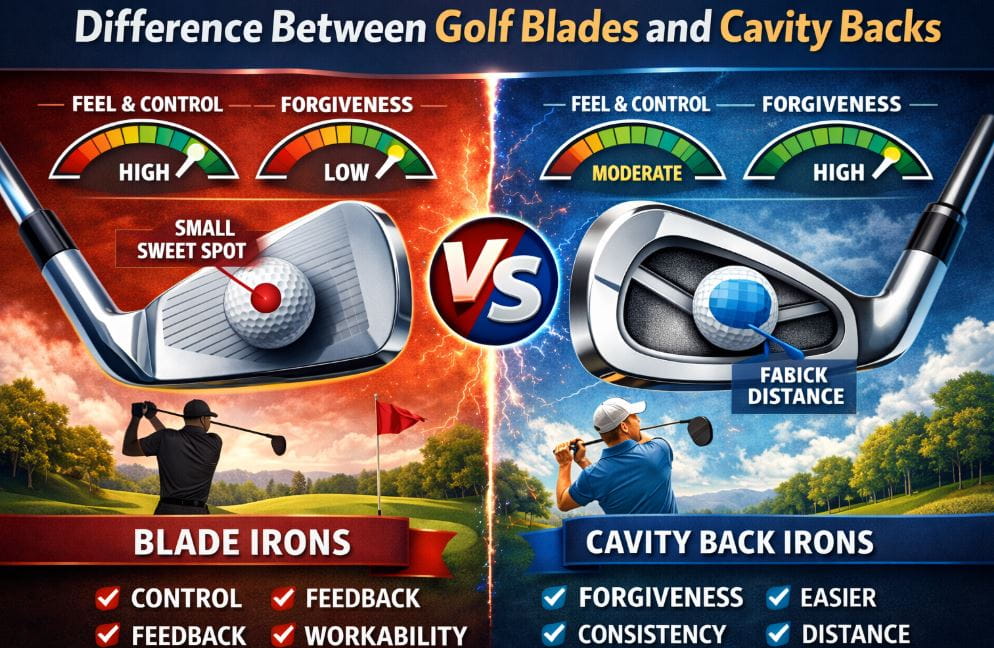
1. Design Difference
Blades:
Solid back
Compact shape
Centered weight
Cavity Backs:
Hollowed back
Larger profile
Perimeter weighting
The design directly affects forgiveness and playability.
2. Forgiveness & Sweet Spot
This is one of the biggest differences.
Blades have a small sweet spot.
Cavity backs have a larger sweet spot.
If you miss the center:
Blades punish you.
Cavity backs reduce the damage.
3. Distance & Launch
Blades:
Lower launch
More consistent spin
Requires a clean strike
Cavity Backs:
Higher launch
More help getting the ball airborne
More distance on off-center hits
4. Feel & Feedback
Blades provide:
Crisp, soft feel on pure shots
Immediate feedback on mishits
Cavity backs provide:
Softer feel overall
Less harsh punishment for mishits
Many better players prefer blades because they can “feel” exactly where they struck the ball.
5. Workability & Shot Shaping
If you want to shape shots:
Blades offer maximum control.
Cavity backs are slightly less workable.
Better players often choose blades because they can easily hit fades and draws.
Difference Between Golf Blades And Cavity Backs Handicap Guide
Your handicap plays a huge role in choosing irons.
0–5 Handicap
Best Choice: Blades or combo set
Reason: You already strike the ball consistently.
6–15 Handicap
Best Choice: Cavity back or players cavity
Reason: You need some forgiveness but still want control.
16+ Handicap
Best Choice: Cavity back
Reason: Forgiveness matters more than shot shaping.
If your main goal is lower scores, forgiveness usually wins.
Blades vs Cavity Back vs Muscle Back
This is where many golfers get confused.
What Is a Muscle Back?
A muscle back iron is essentially a traditional blade with a solid back design and centered mass. Many people use “blade” and “muscle back” interchangeably.
Key Differences
Blade (Muscle Back):
Traditional compact design
Very little forgiveness
Maximum control
Cavity Back:
Perimeter weighting
More forgiving
Easier launch
Quick Comparison
| Feature | Blade / Muscle Back | Cavity Back |
|---|---|---|
| Forgiveness | Low | High |
| Sweet Spot | Small | Large |
| Workability | High | Moderate |
| Best For | Low handicap | Mid to high handicap |
How To Tell If An Iron Is A Blade Or Cavity Back?
Here’s a simple checklist.
1: Look at the Back
Solid back = Blade
Hollowed-out back = Cavity back
2: Check the Topline
Thin topline = Blade
Thick topline = Cavity back
3: Check the Sole
Narrow sole = Blade
Wide sole = Cavity back
4: Look at Clubhead Size
Smaller head = Blade
Larger head = Cavity back
Most manufacturers clearly label their irons as well.
Do Pro Golfers Use Blades Or Cavity Backs?
Many professional golfers prefer blades or muscle backs because they:
Want precise control
Can consistently hit the center
Value workability
However, it’s important to know:
Some pros use combo sets.
Many use cavity backs in long irons.
Forgiveness matters even at elite levels.
So yes, pros often use blades — but not always exclusively.
Pros and Cons Comparison
Blade Irons
Pros
Exceptional feel
High control
Better shot shaping
Cons
Harder to hit
Small sweet spot
Punishing on mishits
Cavity Back Irons
Pros
High forgiveness
Larger sweet spot
Easier to launch
More consistent distance
Cons
Slightly less workability
Less precise feedback
Which One Should You Choose?
Here’s the simple answer.
Choose blades if:
You’re a low handicap golfer
You value feeling and control
You consistently strike the center
Choose cavity backs if:
You want easier playability
You miss the center sometimes
You want more consistent results
For most golfers, cavity backs lower scores faster.
Read also more related topics: Difference Between Golf Ball and Baseball
Which Celebrity Died While Playing Golf In Spain?
Difference Between Golfers’ Elbow And Tennis Elbow
Frequently Asked Questions
Are blades harder to hit than cavity backs?
Yes. Blades require precise ball striking.
Can beginners use blade irons?
They can, but it’s not recommended. Cavity backs are much easier.
Why do better players prefer blades?
Because they offer better control and feedback.
Are cavity backs good for low handicappers?
Yes, especially players’ cavity designs.
Do blades spin more than cavity backs?
Not necessarily. Spin depends more on loft and strike quality.
Final Verdict: Blade Or Cavity Back?
The real difference between golf blades and cavity backs comes down to forgiveness vs control.
Blades reward precision.
Cavity backs protect against mistakes.
If your goal is scoring consistency, cavity backs are usually the smarter choice.
If your goal is shot control and feel — and you have the skill — blades may suit you better.
Choose based on your ability, not ego.