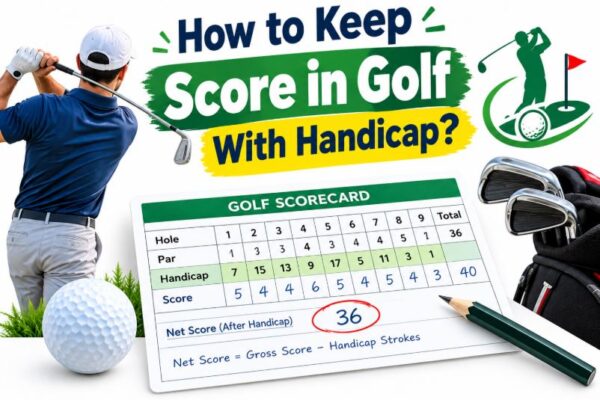
Keeping score in golf becomes far more meaningful—and fair—once you understand how to apply a handicap. Whether you’re tracking personal improvement, competing with friends of mixed abilities, or entering a tournament, knowing how to keep score in golf with handicap levels the playing field so everyone has a real chance to win on the day.
This guide covers everything: what a golf handicap means for beginners, how to establish and maintain one, how to record scores correctly, how to use free calculators, and how handicaps work in tournaments.
What Is a Golf Handicap for a Beginner?
A golf handicap is a numerical measure of a player’s potential ability. Under the World Handicap System (WHS), it is officially called a Handicap Index. It is not your average score. Instead, it reflects what you are capable of shooting on a good day on a course of standard difficulty.
- A lower number means a stronger player.
- A higher number means more strokes are subtracted from your gross score to produce a net score.
For beginners, the system is designed to be welcoming. The maximum Handicap Index is 54.0. You can establish an official index after posting scores for just 54 holes (three 18-hole rounds or any combination of 9- and 18-hole scores). This makes it easy to start how to keep a golf handicap early in your golf journey and track real progress over time.
Gross score = total strokes taken (including penalties).
Net score = gross score minus the handicap strokes you receive.
How to Keep Track of Your Golf Handicap?
To keep an official handicap:
- Join an authorized golf club or association affiliated with your national golf body (or use an approved app that feeds into the official system).
- Play and post scores from rated courses. You need Course Rating and Slope Rating for the tees you play—these appear on almost every scorecard.
- Post an Adjusted Gross Score. Cap any hole at Net Double Bogey (par + 2 + any handicap strokes you receive on that hole). This prevents one disastrous hole from inflating your index unfairly.
- The system calculates Score Differentials for each round and averages the best ones (best 8 of the most recent 20 once you have enough scores).
Once you have a Handicap Index, convert it to a Course Handicap for the specific tees you are playing that day:
Course Handicap = Handicap Index × (Slope Rating ÷ 113) + (Course Rating − Par)
Round the result to the nearest whole number. This is the number of strokes you actually receive on that course.
Many golfers also use free apps and online tools to track everything unofficially while building toward an official index. Consistency in posting accurate scores is the key to how to keep track of your golf handicap.
How to Keep Score in Golf with Handicap (Step-by-Step)
1. Record the gross score on every hole
Count every stroke that moves the ball, plus penalty strokes. Write the number clearly on the scorecard after each hole. For help understanding the layout of a scorecard (including the Stroke Index/Hole Handicap column), see our full guide on how to read a golf scorecard.
2. Determine where you receive strokes
Look at the Stroke Index (or Hole Handicap) column—holes ranked 1 (hardest) to 18 (easiest). If your Course Handicap is 14, you receive one stroke on the 14 hardest holes (Stroke Index 1–14). If it is 25, you receive two strokes on the hardest 7 holes and one stroke on the next 11.
3. Calculate net scores (optional during the round, essential at the end)
On holes where you receive a stroke, subtract 1 (or 2) from your gross score for the net. Many players circle or mark the net number, or simply note the strokes received.
4. Total the card
Add the front nine (Out) and back nine (In) for the gross total. Then subtract the total strokes received (or calculate hole-by-hole nets) to get the net total.
5. Post the Adjusted Gross Score
After the round, apply the Net Double Bogey cap if needed and post the score for handicap purposes.
Example
You have a Course Handicap of 16 on a par-72 course. On a par-4 hole with Stroke Index 7, you take 6 strokes. Because Stroke Index 7 ≤ 16, you receive one stroke → net 5. At the end of the round, your gross total is 92. You received 16 strokes → net score of 76.
How to Keep Score in Golf with a Handicap Calculator (Free Options)
You do not need to do the math by hand every time. Free online golf handicap calculators and apps handle Score Differentials, Handicap Index updates, and Course Handicap conversions instantly. Enter your adjusted gross scores, Course Rating, and Slope Rating; the tool does the rest.
Popular free options include many GPS/score-tracking apps that calculate an unofficial index, as well as dedicated WHS-style calculators on golf sites. Search for “Golf Handicap calculator based on score” or “How to keep score in golf with a handicap calculator free,” and you will find multiple reliable tools. Always verify that the calculator follows the current World Handicap System formulas for best accuracy.
These tools make how to keep handicap score in golf simple and encourage consistent tracking.
How to Score a Golf Tournament with Handicaps
Tournament scoring often uses net scores so players of different abilities can compete fairly. Common formats include:
- Individual stroke play (lowest net score wins)
- Stableford (points based on net score relative to par)
- Match play (strokes applied on specific holes according to the difference in Course Handicaps)
- Team formats (four-ball, foursomes, etc.) with appropriate handicap allowances
Handicap allowances (the percentage of Course Handicap used) vary by format—often 95% or 100% for individual stroke play, different percentages for team events. Always check the tournament conditions. For a complete walkthrough of tournament scoring, formats, and leaderboards, read our guide on how to score a golf tournament.
Related resources on the site include different types of golf tournament formats and how to make a golf leaderboard—useful when organizing or competing in events.
Practical Tips for Accurate Scoring and Handicap Maintenance
- Fill out the scorecard as you play—do not rely on memory.
- Know your Course Handicap before the first tee.
- Use the Stroke Index column correctly; it is not the same as your personal handicap.
- Apply Net Double Bogey for posting, even in casual rounds if you want accurate tracking.
- Review patterns after the round: which holes cost the most strokes relative to your handicap?
- Keep scores from a variety of courses for a more robust index.
Frequently Asked Questions
How do I start keeping a golf handicap as a complete beginner?
Post scores for at least 54 holes through an authorized club or approved system. The WHS will issue an initial Handicap Index with built-in safeguards for limited data.
Do I need a handicap calculator every round?
No. Once you know your Course Handicap for the day, simple subtraction of strokes on the correct holes is enough. Calculators are most useful for updating your Index and converting it to new courses.
What is the difference between Handicap Index and Course Handicap?
Handicap Index is portable and course-neutral. Course Handicap adjusts it for the specific tees and difficulty of the course you are playing that day.
Can I keep a handicap in casual rounds?
Absolutely. Many groups use net scores or Stableford points for friendly competitions. It makes the game more enjoyable for mixed-ability players.
Mastering handicap scoring turns every round into useful data and fair competition. Start by understanding your current scores, posting them consistently, learning the Stroke Index on the card, and using free calculators when needed. Over time, your Handicap Index becomes a clear, motivating measure of progress.
Grab a pencil, play your next round mindfully, and watch both your scores and your understanding improve.