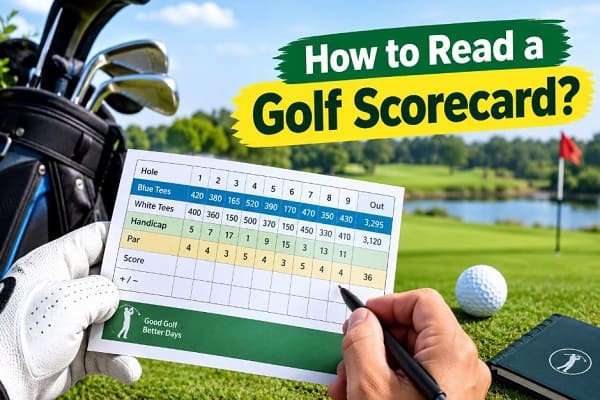
Standing on the first tee with a blank golf scorecard in hand can feel intimidating. Rows of numbers, colored tees, mysterious “handicap” columns, and spaces for scores make it look more complicated than it is. Once you understand the layout, reading a golf scorecard becomes second nature—and it actually helps you play smarter.
This guide covers everything: how to read a golf scorecard, how to read handicap on a scorecard, what the symbols mean, how course and slope ratings work, practical examples, and tips for beginners. By the end, you’ll know exactly how to fill one out, use it for handicaps, and track your game.
What Is a Golf Scorecard and Why Does It Matter?
A golf scorecard is the official record of your round. It lists every hole, the distance from each set of tees, the par for each hole, the relative difficulty ranking (stroke index or hole handicap), and space to write scores for up to four players. It also shows course rating and slope rating—the two numbers that convert your Handicap Index into a Course Handicap for that specific set of tees.
Beyond recording strokes, the scorecard helps with:
- Choosing the right tees for your ability
- Understanding where you get handicap strokes
- Calculating net scores for competitions
- Tracking progress over time
- Following local rules and pace-of-play guidelines
Most cards fold in half: front nine (holes 1–9, often labeled “Out”) on one side and back nine (holes 10–18, “In”) on the other. Some courses print both sides on a single large card.
The Anatomy of a Golf Scorecard: Breaking Down Every Section
When you open a typical scorecard, you’ll see several clear sections. Here’s how to read each one.
1. Course Identification and General Information
At the top, you’ll usually find the course name, logo, address, and sometimes a small map or local rules summary. Look for pace-of-play expectations (commonly 4 hours or less for 18 holes) and any temporary local rules.
2. Hole Numbers
The top row (or left column depending on orientation) lists holes 1 through 18. Holes 1–9 are the front nine (“Out”); holes 10–18 are the back nine (“In”). After hole 9 you’ll see an “Out” or “Front” total column. After hole 18 you’ll see “In” or “Back” and a final “Total.”
3. Tee Boxes and Yardages
Below the hole numbers sit rows for different tee sets, usually color-coded:
- Black or Gold – Championship / longest tees
- Blue – Longer men’s tees
- White – Regular men’s / mid-handicap tees
- Gold or Yellow – Senior/forward men’s or longer women’s
- Red – Forward/women’s / junior tees
Each cell shows the yardage (or meters on some international cards) from that tee to the middle of the green for that hole. At the end of each nine and for the full 18 you’ll see the total yardage from that set of tees. Always play the tees that match your typical driving distance and ability—not the ones that look “harder.”
4. Par for Each Hole
Par is the number of strokes an expert golfer is expected to need. Most holes are par 3, 4, or 5. A standard 18-hole course totals around 70–72. (Not every course is a par 72—some are 70, 71, or even 68–69 on shorter layouts.) The scorecard shows the par for each hole and the total par for the front, back, and overall course. Some cards list different pars from different tees if the design changes significantly.
5. Hole Handicap / Stroke Index (SI)
This is one of the most important columns for anyone playing with a handicap. The numbers 1 through 18 rank the holes by relative difficulty for handicap purposes. Hole handicap 1 (or Stroke Index 1) is the hardest; 18 is the easiest.
These rankings are used to allocate handicap strokes. If your Course Handicap is 12, you receive one stroke on the 12 hardest holes (those ranked 1–12). If you have a Course Handicap of 24, you get two strokes on the hardest six holes and one on the next twelve, and so on. Men’s and women’s stroke indexes are sometimes listed separately.
6. Course Rating and Slope Rating
Near the tee rows or at the bottom of the card, you’ll see two key numbers for each set of tees, for example “72.4 / 135.”
- Course Rating – The expected score for a scratch golfer (Handicap Index 0.0) from those tees under normal conditions. A rating of 72.4 means a scratch player should average about 72.4.
- Slope Rating – A number between 55 and 155 (average is 113) that measures how much harder the course plays for a higher-handicap golfer relative to a scratch golfer. Higher slope = more relative difficulty for bogey golfers.
These two numbers are essential for calculating your Course Handicap. For a deeper explanation of how they work together, see our full guide on Course Rating vs Slope Rating.
7. Player Score Boxes
Blank columns or rows for each player’s name and scores. Most cards have space for four players. You’ll write the gross score (actual strokes taken) for each hole. Many players also mark net scores or Stableford points in the same box using symbols.
8. Totals, Attest, and Date
At the end, you’ll find spaces for Out, In, Total (gross), and often Net. There’s usually a signature line for the player and a marker/attester, plus the date. In competition, these signatures make the card official.
How to Keep Score on a Golf Scorecard?
- Write each player’s name at the top of a column.
- After finishing a hole, record the total strokes taken (including penalties). Count every swing that moves the ball, plus any penalty strokes.
- At the end of the front nine, add the scores and write the total in the “Out” box.
- Do the same for the back nine in the “In” box.
- Add Out + In for the 18-hole gross total.
- If playing with handicaps, calculate net scores (gross minus strokes received on the relevant holes) or convert to Stableford points.
Common scoring symbols many golfers use on the card:
- Circle the score = birdie (1 under par)
- Double circle or square around circle = eagle (2 under)
- Square around the score = bogey (1 over)
- Double square = double bogey
- Triangle or other mark = other special scores
These visual cues make it easy to scan a completed card later.
How to Read Handicap on a Golf Scorecard
“How to read a golf scorecard handicap” and “how to read handicap on scorecard” are among the most common questions. There are two different handicap-related numbers:
- Hole Handicap / Stroke Index – The 1–18 ranking of hole difficulty described earlier. This tells you where you get strokes.
- Your personal Course Handicap – Calculated from your Handicap Index using the course rating and slope of the tees you’re playing. The formula (simplified under the World Handicap System) is roughly:
Course Handicap = Handicap Index × (Slope Rating / 113) + (Course Rating – Par).
Once you have your Course Handicap, look at the stroke index column. You receive one stroke on every hole whose index number is less than or equal to your Course Handicap. Extra strokes for handicaps over 18 go first to the lowest-index holes again.
For handicap posting purposes, there is also a maximum score per hole called Net Double Bogey. That is par + 2 + any handicap strokes you receive on that hole. Scores higher than Net Double Bogey are adjusted downward when posting.
Handicap allowances (the percentage of your Course Handicap actually used in a competition) vary by format—stroke play, match play, four-ball, etc. See our explanation of handicap allowances for details.
Golf Scorecard Example (Walkthrough)
Imagine a simple par-72 course. You’re playing the white tees (Course Rating 71.2 / Slope 128). Your Handicap Index is 14.2, so your Course Handicap calculates to about 16.
On hole 1 (par 4, Stroke Index 7, 385 yards): You take 6 strokes. Because SI 7 is within your 16 strokes, you receive one stroke → net 5.
On hole 2 (par 5, SI 15, 510 yards): You take 7. SI 15 is still within 16 → net 6.
On hole 3 (par 3, SI 3, 165 yards): You take 4. SI 3 ≤ 16 → net 3.
And so on. At the end of the round, you add the gross scores for your total, then subtract the strokes received (or calculate hole-by-hole nets) for the net score.
Many free printable golf scorecard examples and templates are available online if you want to practice filling one out before your next round.
How to Read a Golf Scorecard for Beginners
If you’re new to the game, start with these priorities:
- Find the tees that match your typical distance (most beginners should start on the forward or middle tees).
- Note the par of each hole, so you know what a “good” score looks like.
- Simply write the number of strokes you take—don’t worry about net scores yet.
- Add the front nine and back nine at the end.
- Look at the local rules section so you know how to handle common situations (out of bounds, water hazards, etc.).
Course Rating, Slope, and Choosing the Right Tees
The two numbers next to each tee set are not just decoration. Course Rating tells scratch golfers what they should shoot; Slope tells higher-handicap players how much harder the course will feel relative to that. A high slope (130+) means the course will punish higher handicaps more than a low-slope course of similar rating.
Always choose tees so that your expected score is reasonably close to the course rating for those tees. Playing tees that are too long leads to slow play and frustration; tees that are too short can make the course less interesting. Many modern scorecards even suggest tee recommendations based on typical driving distance or handicap ranges.
For more detail on these ratings, read Can you have a Negative Handicap in Golf?
And the US Open Golf winners list.
Golf Scorecard Apps and Digital Alternatives
While the traditional paper card is still the standard at most clubs, many golfers now use apps that digitize the entire process. Popular options include:
- Official USGA or national association apps for handicap posting
- Course-specific apps that show GPS distances and auto-populate scorecards
- General apps such as 18Birdies, TheGrint, Golfshot, or Arccos that track scores, stats, and handicaps
These tools can calculate Course Handicap automatically, apply Net Double Bogey adjustments, and store historical data. They are excellent supplements, but in formal competition you will still usually need a paper card signed by a marker.
Practical Tips for Using the Scorecard Effectively
- Fill it out as you go—don’t try to remember scores later.
- Write clearly so the card can be read by others (and by yourself months later).
- Use the card as a strategy tool: look ahead at upcoming holes, note long par 3s or reachable par 5s, and plan where you want to take risks.
- In match play, the stroke index tells you exactly which holes the higher-handicap player receives strokes.
- Keep an extra pencil or pen in your bag.
- After the round, review the card for patterns (which holes cost you the most strokes, where you gained strokes against your handicap).
Frequently Asked Questions
How do you read a golf scorecard if you’ve never seen one before?
Start with the hole numbers and par. Then locate the yardage row for the tees you’re playing. Write your score in the player column after each hole. The rest (handicap, ratings) can be learned gradually.
What does the handicap number next to each hole mean?
It ranks the holes from hardest (1) to easiest (18) for the purpose of allocating handicap strokes. It is not your personal handicap.
Is every golf course a par 72?
No. While 72 is common, many courses are par 70, 71, or other totals depending on design and length.
Can I use a golf scorecard app instead of paper?
For casual rounds, yes. For handicap-eligible or competition rounds, follow the club’s or association’s rules—many still require a signed paper card.
Where can I find a free golf scorecard example?
Many club websites and golf associations offer printable blank templates. Searching “free golf scorecard template” will also yield usable examples.
Final Thoughts
Learning how to read a golf scorecard removes one of the last barriers that make the game feel exclusive. Once the numbers make sense, the card becomes a useful tool rather than a source of confusion. You’ll choose better tees, understand where your handicap strokes fall, post accurate scores, and track improvement more effectively.
Next time you step onto the first tee, take thirty seconds to orient yourself on the card. Note the par, the yardage from your tees, and which holes carry the lowest stroke indexes. Then simply play, write the numbers, and enjoy the round. Over time, the scorecard will tell the story of your game—and help you write a better one.