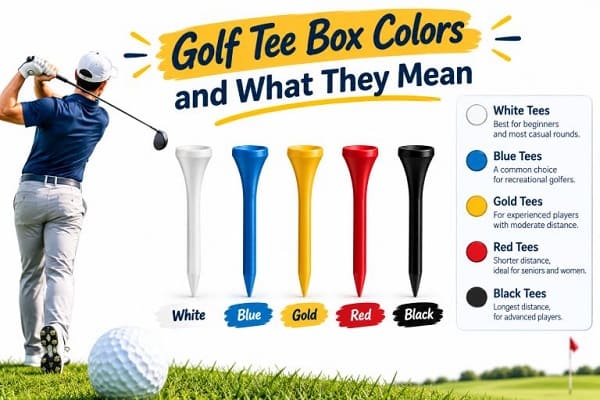
If you’ve ever stood on a tee box staring at a row of colored markers and wondered which ones to use, you’re not alone. One of the most common questions new and intermediate golfers ask is: What are the white tees in golf?
White tees are the standard, middle-distance starting points on most golf courses. Traditionally called the “men’s tees,” “regular tees,” or “club tees,” they offer a balanced challenge for the average amateur golfer. Understanding them—and the full system of golf tee box colors—helps you choose the right tees, play faster, score better, and enjoy the game more.
Golf Tee Box Colors Meaning: The Complete Guide
There is no single universal rule that forces every course to use the same colors. Courses can (and do) invent their own systems. Still, a clear traditional pattern has developed over decades. Here’s how the most common colors typically work, moving from shortest to longest:
| Tee Color | Common Name | Typical Total Yardage | Best For |
|---|---|---|---|
| Red | Forward / Women’s tees | 4,800 – 5,500 yards | Beginners, juniors, shorter hitters |
| Gold / Yellow | Senior / Intermediate tees | 5,400 – 6,000 yards | Seniors, higher handicaps |
| White | Regular / Men’s / Club tees | 5,800 – 6,500 yards | Average male amateurs, mid-handicaps |
| Blue | Championship / Tournament | 6,400 – 7,000 yards | Low-handicap, longer hitters |
| Black / Gold | Tips / Championship | 6,800 – 7,500+ yards | Scratch players & professionals |
What Are the White Tees in Golf?
White tees sit in the middle of this spectrum. On a typical par-72 course, they usually measure between 5,800 and 6,500 yards. Golf Course designers often build the layout with these distances in mind—bunker placement, doglegs, and approach angles are calibrated for the average male amateur who drives the ball roughly 200–240 yards.
You’ll see white markers labeled as “Regular,” “Men’s,” or “Club” on most scorecards. Playing from them gives you a fair test: long enough to require a full bag of clubs, but not so long that every par-4 becomes a three-shot hole.
What Are Blue Tees in Golf?
Blue tees are a clear step back from the whites. They typically stretch the course to 6,400–7,000 yards and are designed for low-handicap players and stronger hitters. If you consistently drive the ball 250+ yards and regularly break 80, the blue tees offer the challenge you’re looking for. For everyone else, they often lead to longer approach shots, higher scores, and slower play.
What Color Are Women’s Tees in Golf?
Traditionally, red tees were called the “ladies’ tees.” That label is outdated. Modern golf treats red (and other forward markers) as the forward tees—available to anyone whose distance matches them. Many women play red, gold, or even white tees depending on their length and skill. The only rule that matters is matching the yardage to your game, not your gender.
What Are Gold Tees in Golf?
Gold (or yellow) tees most often serve as senior or intermediate options. They usually sit between the red and white markers and give players who have lost distance—or who simply prefer a more enjoyable length—a comfortable middle ground.
On some championship courses, gold can instead mark the longest “tips” tees, so always check the scorecard yardage rather than assuming the color’s meaning.
Who Should Play the White Tees?
The best way to decide is by average driving distance (carry, not total distance on a perfect day):
- Driver carry under 180 yards → Red or forward tees
- 180–220 yards → Gold/Yellow or White
- 200–240 yards → White tees (the sweet spot for most mid-handicap golfers)
- 240–275 yards → Blue tees
- 275+ yards → Black or championship tees
Handicap guidelines also help: white tees generally suit players with handicaps between roughly 10 and 24. If you find yourself hitting long irons or hybrids into most par-4s, move forward. If you’re reaching greens with short irons and wedges all day, consider moving back.
Why Choosing the Right Tees Matters
Playing the correct tees improves:
- Scoring and enjoyment
- Pace of play for everyone on the course
- Course strategy (you actually get to use more clubs)
- Confidence and shot selection
Ego is the biggest enemy of good tee selection. The modern approach is simple: pick the tees that let you hit driver + mid-iron into most par-4s. That’s where the game is most fun.
How to Find White Tees on the Scorecard
Most scorecards list each set of tees in color-coded rows with the yardage for every hole and the total for the course. Look for the white row (or the one labeled “Regular” or “Men’s”). You’ll also see the Course Rating and Slope Rating next to each set of tees—these numbers matter when calculating your Course Handicap.
For a full walkthrough of reading every section of a scorecard, including how tee yardages, ratings, and stroke indexes work together, see our detailed guide: How to Read a Golf Scorecard.
Final Thoughts
White tees are the everyday standard for most recreational golfers. They represent the course as it was designed for the average player—challenging enough to be interesting, short enough to stay enjoyable. Once you understand golf tee box colors’ meaning and stop worrying about old gender or age labels, choosing the right markers becomes easy.
Next time you arrive at the first tee, check the scorecard, be honest about your distance, and pick the white (or other) markers that match your game. You’ll play better golf, finish faster, and have more fun.