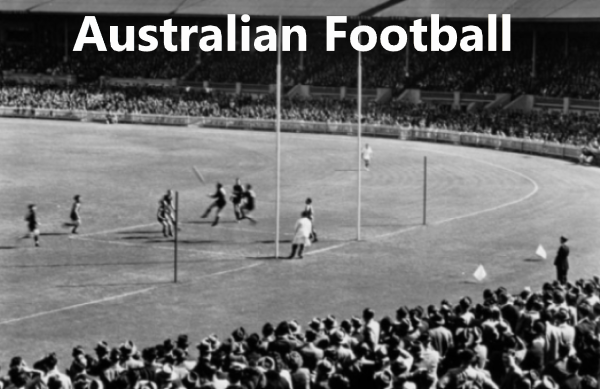
Australian Football, or as it is more commonly known as “Aussie Rules,” is a rapidly growing sport in the United States. It has been popular in Australia since its inception in 1859 and has been played with an average of 20% of Australian adults participating each year.
The game is a rough mix between American football and rugby, but it is a unique set of rules that makes this sport very different from any others.
History of Australian Football
AFL Teams of six players aside, the game is played from a field approximately 60 m in length and 30 m in width, with a goal post at each end. One of the goals is slightly larger than the other, to ensure that the ball goes into the goal. It’s a sport that starts with ”A”
At present, there are 22 team members in the whole field. Aussie Rules started on May 1859 in Melbourne, Victoria, Australia.
A short history of Australian Rules football
A short history of the ARF Australian Rules football, or Aussie Rules is given below.
Full name: Australian Rules football.
Nicknames: Footy, Football, Aussie Rules, etc
Highest Governing body: AFL commission.
First Played: in May 1859
Place: in Melbourne, Victoria, Australia.
Total Registered Players: 1,404,176 (As of 2016)
Total Clubs: 25,770 (As of 2016)
Games type: Outdoor
Mixed Gender: Up to age 14
Equipment: Football
Olympic: Demonstration sport, 1956 Melbourne Olympics.
Total team members: 22 (18 onfield, 4 interchanges)
Rules of Australian Football
The field is divided into two areas, the forward and back areas.
The Rules of Australian Football: Australian Football, also known as Aussie Rules or Australian Rules Football, is a fast-paced and unique sport played with an oval-shaped ball. Here are the key rules that govern this exciting sport:
1. Field and Teams
Australian Football is played on an oval-shaped field with a length of approximately 135-185 meters (147-202 yards) and a width of 110-155 meters (120-170 yards). Two teams, each consisting of 18 players, compete against each other.
2. Scoring
The primary objective is to score goals and behinds. Kicking the ball through the middle goalposts without being touched by any player scores a goal, worth six points. If the ball passes between a goal post and a behind post or hits a goal post, a behind is scored, worth one point.
3. Ball Movement
Players move the ball by kicking, handballing (punching the ball with a closed fist), or running while bouncing it on the ground. Players must legally dispose of the ball, usually within a certain number of steps or while being tackled.
4. Tackling
Players can tackle opponents who have the ball. The tackler must use a “wrap” technique, attempting to pin the arms of the ball carrier to prevent disposal. Tackling above the shoulders or below the knees is not allowed.
5. Marking
A player can take a “mark” by cleanly catching the ball after it has been kicked for at least 15 meters (16.4 yards) by another player. After taking a mark, the player is awarded a free kick and can play on or take a set shot at the goal.
6. Handball and Prior Opportunity
Players can handball the ball (strike it with an open hand) to pass it to teammates. However, they must release the ball before taking possession if they have had prior opportunity, meaning they had a reasonable chance to dispose of the ball before being tackled.
7. Umpires and Penalties
Umpires officiate the game, enforcing rules and awarding free kicks for rule infringements, such as holding, pushing, or incorrect disposal. More serious offenses can result in penalties, such as 50-meter (54.6-yard) penalties or players being reported.
These rules provide a framework for an exciting and unique sport that is deeply embedded in Australian culture.
Don’t miss to watch: FIFA World Cup 2022
Scoring in Australian Football
The team that gets a goal first wins the game.
In the case of a tied game, the game continues until a goal is scored, and then the team that scores the most goals wins. In the case of a tied game, the two tied goals count as one for each team. The match is declared a draw.
The score is kept on an electronic scoreboard and is presented as a total score.
The score is presented to reflect the number of goals, and the number of behinds with the score in brackets. Let’s see an example here 14.13 defeated Richmond 12.07.
In conclusion
In Australian football, the ball is played by the foot. The goal is scored by kicking the ball over the crossbar. The ball is kicked by the player standing in the center of the ground.
Read also related sports