Golfers hear three handicap terms all the time. They are Handicap Index, Course Handicap, and Playing Handicap. Many players use them as if they mean the same thing. They do not.
Understanding Course Handicap vs Playing Handicap tells you exactly how many strokes you get on the day.
It also keeps your scorecard honest and your matches fair. This guide explains both numbers in plain language. You will see the formulas, a worked example, the format allowances, and how a course handicap vs playing handicap calculator fits in.
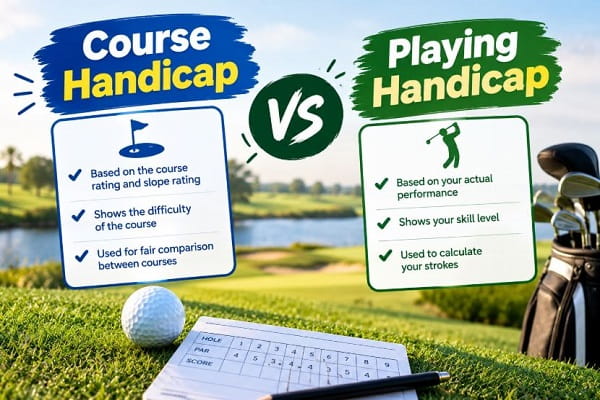
Course Handicap VS Playing Handicap: The Short Answer
- Course Handicap: the number of strokes you need on a specific course and tee set, worked out from your Handicap Index.
- Playing Handicap: your Course Handicap after the competition’s handicap allowance is applied. It is the number of strokes you actually give or receive in that round.
- When the handicap allowance is 100%, both numbers are the same.
- Both start from your Handicap Index.
That is the core difference between Course Handicap and Playing Handicap. One adapts to the course. The other adapts to the format.
Overview of Course Handicap
What Is a Course Handicap?
Your Handicap Index travels with you. It is not tied to one course.
Courses, however, are not equal. A tight layout with fast greens plays harder than a short, open one.
A Course Handicap converts your Index into strokes for the exact course and tees you are about to play.
- The same golfer gets a different Course Handicap at a different course.
- The same golfer can get a different Course Handicap from a different set of tees at the same club.
If you are new to the Index itself, start with this guide to what is the golf handicap index.
Course Handicap Formula
Course Handicap = Handicap Index × (Slope Rating ÷ 113) + (Course Rating − Par)
Each part of the formula has a job.
- Handicap Index: your demonstrated ability on a course of average difficulty. Under the World Handicap System, the maximum is 54.0.
- Slope Rating: shows how much harder the course plays for an average golfer than for a scratch golfer. The number 113 is the standard slope.
- Course Rating: the score a scratch golfer is expected to shoot from those tees.
- Par: the stated par for the tees being played.
- Course Rating minus Par: a small adjustment. It corrects the number when the Course Rating sits above or below par.
What Is a Course Handicap Used For?
- It sets the strokes you receive, or give, on that Golf course.
- It supports the net double bogey adjustment when you post your score.
- It gives you a course-specific number to start from before the format is considered.
For most purposes, the unrounded value is kept until the final step. Rounding too early can shift your strokes by one.
Overview of Playing Handicap
What Is a Playing Handicap?
A Playing Handicap is built on top of your Course Handicap.
It adds one more step: the handicap allowance for the format being played. Why is this needed? Because formats treat luck and skill differently.
A four-ball team can lean on its best score on each hole. A single player in stroke play has no partner to fall back on. Allowances keep the competition fair for players of every level.
Playing Handicap Formula
Playing Handicap = Course Handicap (unrounded) × Handicap Allowance
- The result is rounded to the nearest whole number. A .5 rounds up.
- The allowance should be applied to the unrounded Course Handicap to avoid double rounding.
- In one USGA example, two players with different Indexes both received 9 strokes when the rounded number was used. With the unrounded number, they received 8 and 10 strokes.
- When players in the same group play from tees with different pars, a further adjustment for the difference in pars may apply.
Playing Handicap Allowances by Format
Allowances are recommendations. Committees can adjust them, so always read the Conditions of the Competition.
- Individual stroke play: 95%
- Individual Stableford, par/bogey, and maximum score: 95%
- Individual match play: 100%
- Four-ball stroke play and Stableford: 85%
- Four-ball match play: 90%
- Foursomes: 50% of the two partners’ combined Course Handicaps.
- Greensomes: 60% of the lower Course Handicap plus 40% of the higher one.
Want to know how these formats work on the course? Read about the different types of golf tournament formats.
Difference Between Course Handicap and Playing Handicap
Here is the difference between Course Handicap and Playing Handicap, side by side.
- Purpose: A Course Handicap converts your Index for a course and tee set. A Playing Handicap makes the competition fair for its format.
- Built from: A Course Handicap uses your Index, Slope Rating, Course Rating, and par. A Playing Handicap uses your Course Handicap and the format allowance.
- Changes with: A Course Handicap changes with the course and tees. A Playing Handicap changes with the course, tees, and format.
- Strokes: A Course Handicap shows the strokes for the course. A Playing Handicap shows the strokes you actually give or receive in the round.
- Format effect: A Course Handicap ignores the format. A Playing Handicap depends on it.
- When equal: They match whenever the allowance is 100%, unless an adjustment for multiple tees is needed.
Handicap Index VS Course Handicap vs Playing Handicap
Think of the three numbers as a ladder. Each step builds on the one before.
- Step 1, Handicap Index: your portable measure of ability. It is based on your best 8 score differentials from your last 20 rounds.
- Step 2, Course Handicap: your Index converted for a specific course and set of tees.
- Step 3, Playing Handicap: your Course Handicap adjusted for the format.
A simple way to remember it:
- Handicap Index tells you who you are as a golfer.
- Course Handicap tells you what the course asks of you.
- Playing Handicap tells you what the format allows.
Worked Example: One Golfer, Four Playing Handicaps
Let us use a golfer with a Handicap Index of 14.2.
The tees have a Slope Rating of 125, a Course Rating of 71.4, and a par of 72.
- Step 1: 14.2 × (125 ÷ 113) = 15.71
- Step 2: 71.4 − 72 = −0.6
- Step 3: 15.71 − 0.6 = 15.11 (unrounded Course Handicap)
- Course Handicap: 15
Now apply the allowances to the unrounded figure of 15.11.
- Individual stroke play at 95%: 14.35, so the Playing Handicap is 14.
- Individual match play at 100%: 15.11, so the Playing Handicap is 15.
- Four-ball stroke play at 85%: 12.84, so the Playing Handicap is 13.
- Four-ball match play at 90%: 13.60, so the Playing Handicap is 14.
Same player. Same course. Four different Playing Handicaps.
That is why the format matters as much as the course.
How Strokes Work in Match Play
In match play, players compare their Playing Handicaps.
- Say Player A has a Playing Handicap of 8 and Player B has 22.
- The difference is 14.
- Player B receives one stroke on each of the 14 hardest holes, which are the holes with stroke index 1 to 14.
To see how these strokes affect the scorecard, read how to keep score in golf with handicap and how to score a golf tournament.
Course Handicap vs Playing Handicap Calculator
You do not have to do this maths by hand. A course handicap vs playing handicap calculator does it in seconds.
What You Need to Enter
- Your current Handicap Index.
- The tees you plan to play.
- The Slope Rating, Course Rating, and par for those tees.
- The format of play, so the right allowance is applied.
Where to Find These Numbers
- The scorecard usually lists the ratings for each set of tees.
- Your national golf association’s app can show your Course Handicap.
- Many clubs post a Course Handicap table in the pro shop.
Tips for Using a Calculator
- Pick the correct tees. A wrong tee choice gives the wrong Course Handicap.
- Check that the calculator uses the current World Handicap System formula.
- Check which allowance it applies for your format.
- For official competitions, trust your club’s published numbers.
Common Mistakes Golfers Make
- Treating the Handicap Index as the number of strokes received.
- Forgetting that every set of tees has its own Course Handicap.
- Applying the format allowance twice.
- Rounding the Course Handicap before applying the allowance.
- Ignoring the format, then wondering why a friend gets a different number.
- Mixing up Course Handicap and Playing Handicap when posting a score.
Which Handicap Should You Use?
- Weekly medal or stroke play: use your Playing Handicap at the stroke play allowance.
- Friendly match play round: use your Playing Handicap at the match play allowance, then take the difference between players.
- Posting your score: your Course Handicap is used for the net double bogey adjustment.
- Running an event: set the allowances in the Conditions of the Competition. Then make a golf leaderboard that shows net scores clearly.
- Professional golf: pros play off gross scores, so handicaps do not apply. See how LIV Golf scoring works for one example.
- Elite qualifying: amateur entrants usually need a very low Handicap Index. Here is how to qualify for the Open Championship.
Frequently Asked Questions
What is the difference between Course Handicap and Playing Handicap?
A Course Handicap converts your Handicap Index into strokes for a specific course and tee set. A Playing Handicap applies the competition’s allowance to that number.
Is Playing Handicap the same as Course Handicap?
Only when the allowance is 100%. In most formats, the Playing Handicap differs.
Is a Playing Handicap higher or lower than a Course Handicap?
It is usually the same or lower, because most allowances are 100% or less.
Does my Handicap Index change from course to course?
No. Your Index stays the same. Only your Course Handicap changes.
How do I calculate my Playing Handicap?
- First, find your Course Handicap with the formula.
- Next, multiply the unrounded figure by the allowance.
- Finally, round to the nearest whole number.
Do I need a calculator?
No, but it saves time and avoids errors. A club app or Course Handicap table works just as well.
Do golf professionals use handicaps?
No. Professional events are played off gross scores.
Conclusion
The debate of Course Handicap vs Playing Handicap becomes simple once you see the ladder.
- Your Handicap Index shows your ability.
- Your Course Handicap fits that ability to the course and tees.
- Your Playing Handicap fits it to the format.
Know all three, and you will always know how many strokes you get. Check the course, check the tees, check the format, and play your round with confidence.