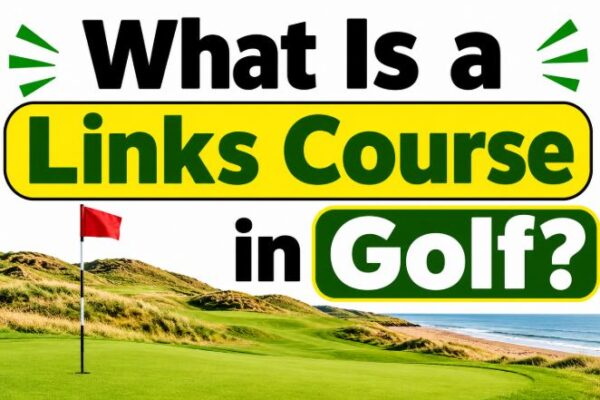
A links course is a golf course built on sandy, undulating land by the sea, with firm turf, few trees, and strong winds. The word “links” describes the type of land, and it is the oldest style of golf course in the world. Links golf differs from inland golf because the ground, wind, and bunkers all work in their own way.
This guide explains what a links course means, why it is called links, and how links golf differs from regular golf. It also covers the opposite of a links course, a list of famous links courses, and what 18 holes of golf are called.
What Is a Links Course in Golf?
- A links course is built on linksland, which is sandy coastal ground between the sea and farmland.
- The land is rolling, with dunes, hollows, and natural ridges.
- The soil is sandy and drains well, so the course stays playable even after heavy rain.
- The grasses are tough native types, such as fescue and bentgrass.
- There are very few trees, so the wind is a key part of the challenge.
- Many holes are laid out by following the natural shape of the land.
Golf Monthly gives a clear explanation in its guide to what a links golf course is.
What Does a Links Course in Golf Mean?
- “Links” first described a strip of coastal land, not a golf course.
- The land was too sandy for farming, so it was free for sport.
- Early golfers in Scotland used this land for their new game in the 15th and 16th centuries.
- The word then became the name for the courses built on it.
- Today, golfers use it for a specific style of coastal, wind-swept golf.
Why Is It Called Links Golf?
- The word comes from the Old English “hlinc,” meaning a ridge or rising ground.
- In Scotland, it came to mean the ridged, sandy ground that links the sea and the fields.
- Golf began on this ground, so the courses took the name of the land.
- Some people think the word means the course “links” the front and back nine, but that is not the real origin.
Scottish Golf History explains the origin in its page on the meaning of links.
GolfingForeAll also lists the Old English root in its glossary entry for links.
What Is the Difference Between Links Golf and Regular Golf?
- Location: links courses sit on the coast, and regular courses are usually inland.
- Ground: links turf is firm and sandy, while regular courses have softer, greener turf.
- Trees: links courses have almost none, while regular courses are often lined with trees.
- Wind: links courses are open to strong coastal winds, and regular courses are more sheltered.
- Bunkers: links courses have deep pot bunkers, and regular courses have a wider range of bunker styles.
- Shot style: links golf rewards low shots that run along the ground, and regular golf more often rewards high, soft shots.
- Layout: links holes follow the natural land, and regular courses are often shaped with moved earth.
- Weather: links golf can change from calm to wild in a few minutes.
For how course ratings capture difficulty, see course handicap vs playing handicap.
What Is the Opposite of a Links Golf Course?
The usual opposite is a parkland course.
- A parkland course is inland and has trees, lakes, and lush grass.
- The ground is softer, so the ball lands and stops quickly.
- Fairways are often tree-lined, and shots in the air matter more.
- Many courses in the United States and in mainland Europe are parkland courses.
Other course types include heathland, desert, mountain, and woodland courses.
Links vs Parkland: Quick Comparison
- Links: coastal, sandy, firm, treeless, windy.
- Parkland: inland, soft, green, tree-lined, sheltered.
- Links: you use the ground to roll the ball to the target.
- Parkland: you fly the ball to the target.
True Links vs Links-Style Courses
- A true links sits on genuine coastal linksland.
- A links-style course copies the look of a links, but it is built elsewhere.
- Many courses use “links” in their name without meeting the true links definition.
- Only about 246 to 247 courses in the world count as true links.
- Most of them are in the United Kingdom and Ireland.
The figure comes from the book True Links and the Links Association, and it is quoted in Glenmuir’s guide to links golf.
Counts vary slightly by source, so treat the number as approximate.
Links Golf Course List: Famous Examples
Scotland
- The Old Course at St Andrews.
- Muirfield.
- Carnoustie.
- Royal Troon.
- Turnberry.
- Royal Dornoch.
England
- Royal Birkdale.
- Royal Lytham and St Annes.
- Royal Liverpool (Hoylake).
- Royal St George’s.
Ireland and Northern Ireland
- Royal Portrush.
- Royal County Down.
- Ballybunion.
- Lahinch.
- Portmarnock.
Other Links and Links-Style Courses
- Cabot Links in Nova Scotia, Canada, which is described as a true links.
- Bandon Dunes in Oregon, which is a famous coastal links-style resort.
- Kiawah Island and Whistling Straits, which are known for their links-style looks.
This is a short list, not a full one, and rankings change from year to year.
Wikipedia has a broader overview in its article on links (golf).
Links Courses and The Open Championship
- The Open Championship is played on links courses only.
- It rotates among a group of courses often called the Open rota.
- The rota includes St Andrews, Muirfield, Carnoustie, Royal Troon, Turnberry, Royal Birkdale, Royal Lytham and St Annes, Royal Liverpool, Royal St George’s, and Royal Portrush.
- The Open was first played in 1860 at Prestwick Golf Club in Scotland.
- Wind and firm ground make the scores much less predictable than on soft inland courses.
To see how players earn a place, read how to qualify for the Open Championship.
For other majors and team events, see the US Open golf winners, the Ryder Cup winners list, and Presidents Cup 2026.
How to Play Links Golf
- Keep the ball low, especially into the wind.
- Use the ground, and let the ball bounce and roll to the green.
- Play a bump-and-run shot instead of a high pitch when the ground is firm.
- Choose a lower-lofted club around the green, and sometimes use a putter from the fringe.
- Take more club into the wind, and less with the wind behind you.
- Avoid pot bunkers, because getting out can cost a stroke or more.
- Stay patient, because the weather can change quickly.
Modern equipment helps with wind and distance, as covered in how golf club technology has changed.
You can also read about iron styles in the difference between golf blades and cavity backs.
What Are 18 Holes of Golf Called?
- Eighteen holes of golf are called a round.
- A full round has 18 holes, played in order.
- The first nine holes are the front nine.
- The last nine holes are the back nine.
- A course with 18 holes is called an 18-hole course.
- Many golfers also call it a regulation round.
The Old Course at St Andrews set the 18-hole standard, as explained in our guide to how many holes are in a round of golf.
For timing, read how long 18 holes of golf take.
To keep track of scores, see how to read a golf scorecard.
Are Links Courses Harder?
- Links courses can be harder on windy days.
- They can also be easier, because wide fairways and firm ground help the ball roll.
- The difficulty comes from wind, bunkers, and uneven lies.
- Course and slope ratings show how hard each set of tees is for you.
- Choosing the right tees makes a big difference, as explained in what the white tees in golf are.
Links Golf and Handicaps
- Links courses have a course rating and slope rating, like any other course.
- Your scores there count for your Handicap Index if you play by the rules.
- Windy days can raise your scores, and the system adjusts for unusually hard conditions.
To learn how scores become an index, read the guides on the golf handicap index, the score differential in golf, and how to keep score in golf with a handicap.
Links Golf Events and Games
- Links trips are popular golf holidays, especially in Scotland and Ireland.
- Friendly team formats work well in windy weather.
- Match play and team games keep the group moving.
Organizers can plan with how to organize a golf tournament, golf league formats, and different types of golf tournament formats.
For friendly games, see greensomes vs foursomes, what a Nassau is in golf, and what a gimme is in golf.
You can also read about a seaside variation in beach golf rules, history, and scorecard.
What Is a Links Course in Golf? FAQs
What is a links course in golf?
It is a golf course built on sandy coastal land, with firm turf, few trees, deep bunkers, and strong wind.
What does a links course in golf mean?
It means a course built on linksland, the sandy strip of land between the sea and the farmland.
Why is it called links golf?
The word comes from the Old English “hlinc,” and golf began on this kind of land in Scotland.
What is the opposite of a links golf course?
A parkland course, which is inland, green, and tree-lined, is the usual opposite.
What is the difference between links golf and regular golf?
Links golf is coastal, firm, treeless, and windy, while regular golf is usually inland, softer, and more sheltered.
What are some famous links golf courses?
Famous examples include the Old Course at St Andrews, Carnoustie, Royal Troon, Royal Birkdale, Royal Portrush, and Ballybunion.
What are 18 holes of golf called?
A full round of golf, or a regulation round.
How many links courses are there in the world?
About 246 to 247 true links courses, depending on the source.
Final Thoughts
A links course is built on sandy coastal land, and it plays firm, fast, and windy. The word links comes from the land itself, and it is where golf began.
Keep the ball low, use the ground, and enjoy one of the most traditional ways to play the game.
To explore another golf term, read can you have a negative handicap in golf?